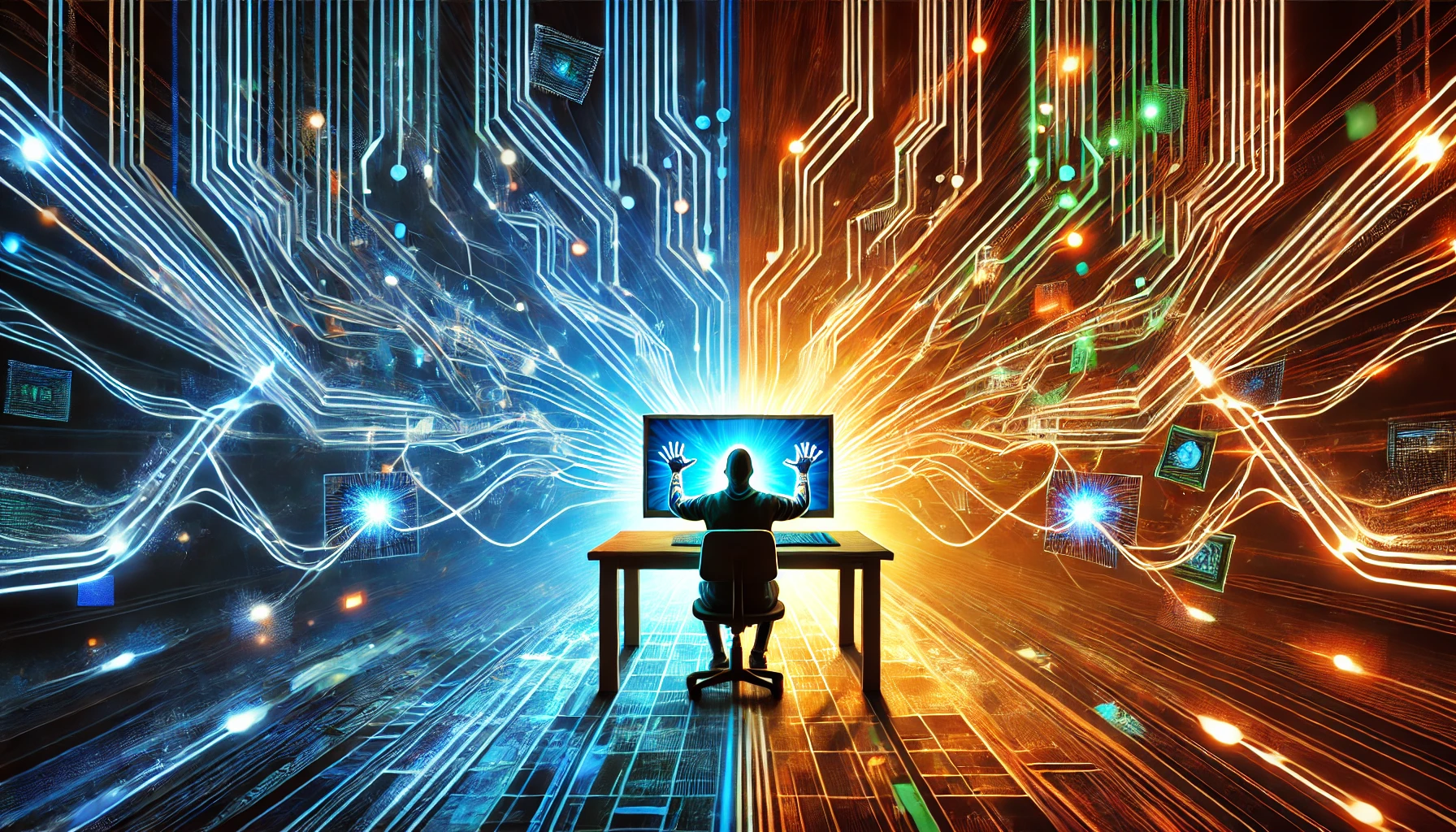
Are You Programming Your Computer, or Is Your Computer Programming You?
Most people assume they’re in control of their technology—but in reality, the companies behind your feeds have spent billions designing them to hold your attention.
- They’ve engineered apps to be addictive.
- They’ve studied brain chemistry to maximize your engagement.
- They’ve tuned their products so that a feed feels more rewarding than real life.
The result? Most people are more addicted to their screens than they realize—and it’s destroying their ability to focus, create, and experience real fulfillment.
Introduction – The Illusion of Control
For most of my life, I thought I was using my devices—until I started noticing something:
- I wasn’t choosing when to check my phone—my phone was deciding for me.
- I wasn’t choosing what to watch—algorithms were curating my options.
- I wasn’t using my computer—it was using me.
Because here’s the truth:
A feed isn’t neutral—it’s designed to keep you scrolling.
- Apps and platforms are intentionally built to hijack your attention.
- Social media isn’t just “distracting”—it’s engineered to be addictive.
- Your phone is a tool, and it is also a slot machine, depending on which app is open.
How Technology Is Addicting You (On Purpose)
1. The Habit-Forming Loop: How Apps Hijack Your Brain
Tech companies use habit loops to create addiction. Here’s how it works:
- Trigger: A notification, a red dot, or an autoplay feature.
- Action: You open the app, check the message, scroll the feed.
- Reward: Your brain gets a small dopamine hit, reinforcing the habit.
- Repeat: The more you do it, the stronger the loop becomes.
Example: Ever open your phone for one thing, but 20 minutes later you’re still scrolling? That’s not accidental—it’s engineered.
2. Dopamine Manipulation: Why Screens Are More Addictive Than Real Life
Dopamine is your brain’s reward chemical. It drives motivation, pleasure, and focus.
- In nature, dopamine is released in small amounts for effort-based rewards.
- Technology shortcuts this system, flooding your brain with dopamine instantly.
This creates a major problem:
- When you flood your brain with dopamine from screens, real-life rewards start to feel dull.
- Hobbies, work, relationships, and learning no longer feel as stimulating.
- Over time, your brain builds a tolerance, and you need even more digital stimulation just to feel normal.
Example: If you spend hours on social media or gaming, a simple walk outside or reading a book won’t feel as rewarding anymore. Your brain has been rewired for high-intensity, instant dopamine hits.
3. The Long-Term Consequences: Why Tech Addiction Is Destroying Your Happiness
Over time, this addiction to instant digital rewards has major consequences:
- Reduced attention span: You struggle to focus on deep work or conversations.
- Decreased motivation: Real-life goals feel slow and unexciting compared to instant digital rewards.
- Increased anxiety and depression: Social media amplifies comparison and discontent.
- Weakened self-control: Dopamine desensitization makes it harder to resist distractions.
Example: Take a week off social media and notice what happens to your attention span and your mood. Most people do not need a study to tell them the result.
How to Reclaim Your Brain and Stop Letting Tech Control You
1. Reduce Dopamine Hijacking
- Turn off every notification that is not a person trying to reach you.
- Delete the apps whose only job is a feed, and use the browser version when you actually need them.
- Keep the phone out of the bedroom and off the desk while you work.
2. Take Control of Your Digital Environment
- Use grayscale mode to make your phone less visually stimulating.
- Set app timers and let them win.
- Make the default screen a blank one: no feed on the home screen, no autoplay anywhere.
3. Rewire Your Brain for Real-Life Rewards
- Start small: read a book, go for a walk, do an hour of deep work without distractions.
- Expect the first week to feel boring. That boredom is your reward system recalibrating.
- Replace consumption with creation: write, build, make, publish.
4. Know the Difference Between a Feed and a Tool
Not every screen is the enemy. The difference is direction. A feed pushes an endless stream at you and measures success by how long you stay. A tool waits for you to bring it a problem, helps you solve it, and measures success by whether you got better. A math app that only moves you forward once you have mastered the material is a tool. A video app that autoplays the next clip is a feed. Kids and adults both need less of the second and more of the first, and the same device can be either.
Conclusion – Are You Programming Your Computer, or Is It Programming You?
Most people:
- Believe they are in control of their technology—but their tech is controlling them.
- Think they are choosing what to watch, read, and do—but algorithms are making those choices for them.
- Don’t realize their dopamine system has been hijacked—making real life feel dull compared to screens.
But the truth?
- Your ability to focus, create, and be happy depends on taking control of your technology.
- If you don’t actively rewire your brain, digital addiction will keep you in a loop of distraction and dissatisfaction.
- Freedom isn’t just about financial independence—it’s about mental independence.
The real question is:
Are you controlling your technology, or is your technology controlling you?